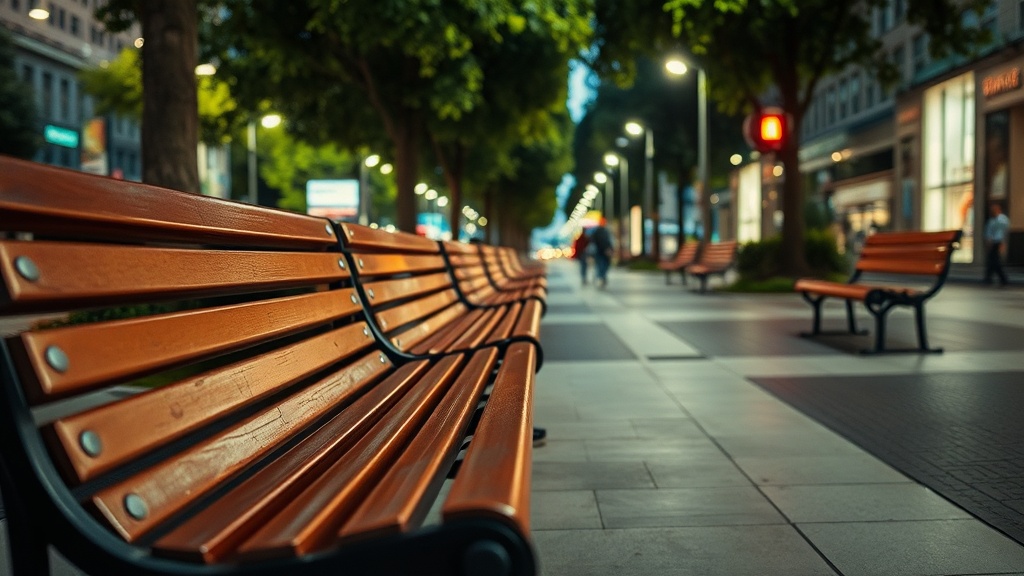
What City Benches Reveal About Who Gets to Belong in Public Space
The 3 PM Dilemma Every Urban Walker Faces
You have been walking since morning. Your phone says you have covered nine miles through the city center — past the cathedral, through the market, down the shopping boulevard that every guidebook mentions. Your feet throb. Your shoulders ache from the bag you swore would be light enough. And now, in this particular square, with the afternoon sun finally breaking through, you face a problem that no travel blog prepared you for: there is nowhere to sit down.
This is not a coincidence. The absence of benches in many city centers is a design choice — one that says more about urban priorities than any architectural landmark ever could. In an era when cities compete for tourism revenue and trumpet their "walkability," the question of where (and whether) strangers are allowed to rest has become a revealing fault line in how public space actually functions.
Why Do Some Cities Remove Benches While Others Add More?
The answer, frustratingly, depends on which city you are standing in — and which decade you are standing in it. In the 1980s and 1990s, many American and British cities deliberately removed public seating as part of "hostile architecture" campaigns designed to discourage unhoused people from resting in business districts. The logic was brutally simple: if there is nowhere to sit, people will keep moving. New York's Pennsylvania Station eliminated most of its benches during renovations. London's South Bank — now celebrated as a cultural destination — went through years of removing seating to "reduce loitering."
But other cities moved in the opposite direction. Copenhagen's famous bench program, expanded significantly since 2010, treats seating as public infrastructure no less important than roads or water pipes. The city's strategy documents explicitly frame benches as tools for "mental health, social inclusion, and extended use of public space." They are not charity — they are calculated investments in keeping downtowns alive after 6 PM. Copenhagenize Design Company has documented how this approach correlates with longer shopping hours, higher foot traffic in winter months, and measurable increases in residents reporting that they "feel welcome" in central districts.
The difference between these approaches is not really about money. It is about who the city imagines its public space is for.
What Does Bench Placement Reveal About Surveillance and Control?
Look closely at where benches do exist, and you can read the anxieties of urban planners like a text. Benches in high-traffic areas often face inward — toward fountains, toward planters, toward anything except the shops behind them. This is not accidental. Seating that allows people to watch storefronts is seating that enables shoplifting, or so the theory goes. Better to have tourists stare at water features than to let them rest in ways that might inconvenience commerce.
Then there is the question of armrests. The middle armrest — that divider that prevents someone from lying down flat — has become the most common form of hostile architecture in wealthy cities. It sends a clear signal: you may sit here briefly, but you may not stay. You may recover, but you may not rest. In cities like San Francisco and Los Angeles, where housing instability is visible on every downtown block, these small metal barriers have become symbols of a deeper conflict over who gets to occupy space without spending money.
But the most telling design feature is often what is missing: backs. A backless bench — the flat plank mounted on two legs — is cheaper to maintain and harder to sleep on. It is also exhausting to use for more than twenty minutes. Your body works to keep you upright. Your feet stay tense against the ground. You are sitting, technically, but you are not resting. You are pausing before you move along.
Where Can You Actually Rest in Cities That Resist Sitting?
Experienced travelers learn to read the landscape differently. In cities with aggressive anti-sitting policies — parts of London, Manhattan south of 14th Street, central Paris during peak tourism seasons — the real resting places hide in plain sight.
Hotel lobbies are the classic solution, but they require confidence and decent clothing. Better options are often found in the spaces between functions: the atrium of a public library (even if you do not have a card), the ground floor of large university buildings (where no one checks credentials during daytime hours), or the waiting areas in hospital complexes (which are designed for exhausted people and rarely questioned).
In Asian megacities, the answer is often vertical. Tokyo and Seoul have developed elaborate "depachika" food halls in department store basements, where the lack of formal seating is offset by abundant leaning space at counters and railings. The culture accepts that you will stand, eat, and move — but you will do so in climate-controlled comfort with a surface in front of you. It is not rest in the European sense, but it is recovery.
European cities with strong cafe cultures offer a different contract: buy a single espresso for €1.50 and you have purchased the right to sit for hours. In Lisbon, in Vienna, in older neighborhoods of Rome, the outdoor seat is understood as rented space — not by the hour, but by the transaction. This is why locals in these cities linger so long over tiny drinks. They are not being slow; they are being economical. The Guardian's coverage of European cafe culture explores how these spaces function as unofficial living rooms for people in small apartments.
How Are Cities Reimagining Public Rest?
The backlash against hostile architecture has produced some genuine innovation. Amsterdam's "sit-able city" initiative (their term, not mine) has installed benches with integrated charging ports, making them attractive to phone-dependent tourists while simultaneously serving older residents who need to rest during errands. The benches are wide, back-supported, and positioned to face human activity rather than blank walls.
More radically, some cities are experimenting with "resting infrastructure" that does not look like benches at all. Wide steps — the kind built for architectural effect rather than practical climbing — have become improvised seating in redesigned plazas from Medellín to Melbourne. Sloped landscaping at the edges of parks invites sitting without formalizing it as "loitering." These designs exploit a loophole in anti-resting regulations: if the object is not technically a bench, it is harder to ban people from using it as one.
The most interesting experiments are happening in cities with extreme climates. In Singapore, where heat makes walking genuinely dangerous for some populations, the government has built an extensive network of covered "linkways" between buildings that function as linear resting spaces. You are technically walking, but you are doing so in shade, with handrails, at a pace that accommodates older bodies. Singapore's Urban Redevelopment Authority master plans explicitly prioritize "thermal comfort" as a design metric — a recognition that a city hostile to rest is a city hostile to certain categories of people.
When you travel, you learn to notice these things. The city that provides places to sit — real places, with backs and shade and no time limits — is saying something about its understanding of dignity. It is acknowledging that human bodies tire, that not everyone can afford a €5 coffee to access a chair, that public space is meant to be occupied rather than merely passed through. The next time you find yourself hunting for a bench in an unfamiliar city, pay attention to what you find. The absence speaks as clearly as any landmark.