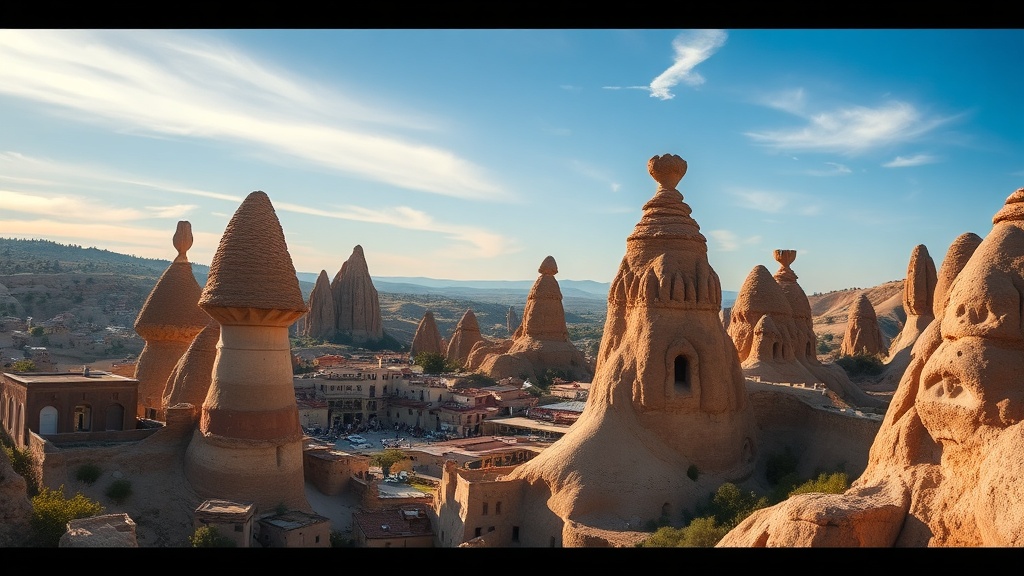
Exploring Cappadocia's Fairy Chimneys: A path Through Turkey's Ancient Cave Cities

Cappadocia's fairy chimneys — those surreal, mushroom-shaped rock formations piercing the Anatolian sky — represent one of Earth's most otherworldly landscapes. This guide explores everything from underground cave cities carved by ancient hands to hot air balloon rides at dawn, plus where to stay, what to pack, and how to experience Turkey's most photogenic region without the tourist crush.
What Are the Fairy Chimneys and How Did They Form?
The fairy chimneys ( peri bacaları in Turkish) are the result of millions of years of volcanic activity followed by wind and water erosion. Around 60 million years ago, eruptions from Mount Erciyes, Mount Hasan, and Mount Güllü blanketed the region in thick ash that solidified into soft tuff rock. Over millennia, rain and wind sculpted this stone into thousands of cone-shaped pillars — some towering 130 feet high.
The distinctive caps? Those are harder basalt and andesite rocks that resisted erosion, creating the mushroom appearance. Locals once believed supernatural beings lived inside them (hence the name). The reality is equally fascinating — humans have occupied these formations for at least 4,000 years.
The best viewing spots cluster around Göreme National Park and the town of Ürgüp. Rose Valley delivers sunset colors that turn the rocks blood-orange. Love Valley — yes, named for the phallic shapes — offers hiking trails threading between towering formations. You'll want sturdy boots. The terrain crumbles underfoot.
"The terrain looks like someone described Mars to a medieval painter, then that painter got really enthusiastic about beige."
Which Ancient Cave Cities Should You Visit?
Derinkuyu and Kaymaklı rank as the largest and most accessible underground cities, though dozens pepper the region. These weren't mere shelters — they were subterranean metropolises housing up to 20,000 people across eight levels.
The cave cities served as hideouts during invasions. Christians escaping Roman persecution carved chapels into the rock. Later inhabitants expanded the networks to escape Arab raids. The engineering astonishes: ventilation shafts, rolling stone doors, wells, wineries, schools, and even stables for livestock.
Here's how the major sites compare:
| Site | Depth | Key Features | Best For |
|---|---|---|---|
| Derinkuyu | 85 meters | Deepest excavated levels, connects to Kaymaklı via tunnel | Thrill-seekers, claustrophiles |
| Kaymaklı | 55 meters | Better lighting, wider passages, less crowded | Families, accessibility needs |
| Özkonak | 40 meters | Unique communication pipes, smaller crowds | Off-the-beaten-path explorers |
| Göreme Open Air Museum | Surface level | 10th-century rock churches with frescoes | Art and history buffs |
Arrive early. Tour buses descend by 10 AM. The narrow passages bottleneck quickly — some sections require single-file shuffling in semi-darkness. Not recommended if you're prone to panic in confined spaces. (There's a reason these places stayed hidden for centuries.)
What's the Best Way to Experience a Cappadocia Hot Air Balloon Ride?
Book with Royal Balloon or Butterfly Balloons — both maintain impeccable safety records and employ seasoned pilots who've logged thousands of flights over the valleys. Prices range from €180-250 for standard baskets, €350+ for intimate 8-12 person flights.
The experience begins before dawn. Vans collect passengers around 4:30 AM for a light breakfast while pilots check wind conditions. Watching the inflation — massive fans roaring, flames whooshing into colorful envelopes — builds anticipation better than coffee ever could.
Takeoff feels like drifting upward rather than lifting off. The silence surprises most first-timers. No engine noise — just occasional burner blasts and fellow passengers whispering. From 3,000 feet, Cappadocia spreads below like a relief map: valleys ribbed with erosion patterns, pigeon houses dotting cliff faces, hundreds of other balloons floating in the morning light.
The flight lasts roughly 60-90 minutes. Landings can be bumpy — pilots often tip the basket intentionally to stop momentum. Champagne toasts follow (a ballooning tradition dating to 18th-century France). You'll receive a flight certificate. It's touristy. You'll treasure it anyway.
Weather cancels roughly 30% of flights, especially in winter. Build buffer days into your itinerary. Don't schedule your balloon ride for your final morning — you might miss out entirely.
Practical Tips for Balloon Bookings
- Book 2-3 months ahead for peak season (April-October)
- Layer clothing — temperatures at altitude drop 10-15 degrees
- Skip the cheapest operators — maintenance corners get cut
- Bring a wide-angle lens — standard zooms can't capture the balloon density
- Request a corner position in the basket for unobstructed photos
Where Should You Stay — Cave Hotels or Modern Resorts?
Cave hotels offer the quintessential Cappadocia experience. Properties like Museum Hotel in Ürgüp and Sultan Cave Suites in Göreme convert actual rock formations into luxury accommodations. Thick stone walls maintain constant 18°C temperatures year-round. No air conditioning needed. Sound doesn't penetrate. Sleep comes deep and dreamless.
The aesthetic matters too. Exposed stone arches. Hand-woven Turkish carpets. Copper hammam bowls repurposed as sinks. Rooftop terraces where breakfast arrives while balloons drift past. It's Instagram catnip — but also genuinely magical.
That said, cave rooms aren't for everyone. Ceiling heights vary unpredictably. Tall guests bump heads. Some bathrooms lack natural light. Wi-Fi signals struggle through stone. If you prefer predictability, chains like DoubleTree by Hilton in Avanos offer standardization with Cappadocia views.
Most travelers split the difference — two nights in a cave hotel for the experience, then something conventional elsewhere in Turkey. The region rewards movement anyway.
When's the Best Time to Visit Cappadocia?
Spring (April-May) and autumn (September-October) deliver ideal conditions — mild days around 20°C, cool evenings, minimal rain, and stable balloon weather. Wildflowers carpet the valleys in April. Vineyard harvests begin in September.
Summer brings crowds and intense heat. Temperatures climb past 35°C. The rock formations radiate warmth. Hiking becomes an endurance test. Hotel prices spike. If summer's your only option, schedule outdoor activities for early morning and late afternoon.
Winter offers a different Cappadocia entirely. Snow dusts the fairy chimneys. Balloons float above frost-white valleys. Hotels slash prices by 50%. The catch? Cold (sub-zero nights), shorter daylight hours, and frequent flight cancellations. Pack thermal layers and flexible plans.
What Else Should You Know?
Food in Cappadocia deserves attention beyond the tourist restaurants. Try testi kebab — meat and vegetables slow-cooked in sealed clay pots that servers crack open tableside. The pottery capital of Avanos (where the red clay comes from) offers workshops where you'll shape your own on traditional kick wheels.
Getting around requires planning. Public buses connect major towns infrequently. Renting a car from Avis or Enterprise at Kayseri or Nevşehir airports provides freedom — roads are well-maintained, signage is clear. ATVs and scooters work for short distances but get uncomfortable fast on the region's rocky terrain.
Souvenir hunters: skip the airport gift shops. The Göreme market stocks authentic hand-painted ceramics, silver jewelry from Mardin, and hand-knotted carpets at negotiable prices. Bargaining is expected. Start at 40% of the asking price. Walk away once — you'll likely get called back.
Cappadocia isn't a place you rush through. Three full days minimum. Four is better. The terrain reveals itself slowly — a fresco detail you missed, a hidden church accessed by unmarked trail, the way sunset light transforms stone into gold. You'll leave with camera cards full and plans to return. Most people do.